
Did you know the very best ancient ruins, cliff dwellings, and petroglyphs in the United States are located where Utah, Arizona, Colorado, and New Mexico meet? Not only that, but there are several national parks and monuments in the area as well as beautiful scenery on tribal lands, and it’s not crowded!
To see the best of the Four Corners, visitors should plan on 7 days. This will give them adequate time to visit the top national park sites, including Mesa Verde, Petrified Forest, Hovenweep, Chaco Canyon, Canyon de Chelly, and Aztec Ruins, as well as Monument Valley Tribal Park. There are also a few incredible drives, including the Moki Dugway, Trail of the Ancients, and Valley of the Gods. The Durango and Albuquerque airports are the most convenient, and it’s best to visit in early spring or fall.
I’m Cheryl, and I live in Utah. I have visited the Four Corners area four times, and exploring the desert is one of my favorite things to do. What I love the most about the Four Corners is that many of these sites are off the radar for most people, so they don’t usually require reservations and are easy to visit. Read on for the exact itinerary we tell family and friends to follow when they visit this amazing area.

The Four Corners area is where Arizona, Utah, Colorado, and New Mexico meet. Although there is actually a monument called the “Four Corners,” when people use this term, they are often referring to this region. Most famous for its ancient ruins like cliff dwellings, great houses, kivas, and pueblos, there are also beautiful red rock formations, gorgeous drives, and even petrified wood!
The sites are a mixture of national parks and monuments, state parks, and Navajo tribal land. These sites are close enough to be seen on one trip, but are far enough apart that you will want to switch lodging locations occasionally.
| Mesa Verde | Monument Valley | Petrified Forest | Chaco Canyon | Canyon De Chelly | |
| Mesa Verde | 2 hr 45 min | 4 hr 45 min | 3 hr 30 min | 3 hr 15 min | |
| Monument Verde | 2 hr 45 | 3 hr 30 min | 4 hr | 2 hr | |
| Petrified Forest | 4 hr 45 | 3 hr 30 min | 3 hr 30 min | 2 hr 30 min | |
| Chaco Canyon | 3 hr 30 min | 4 hr | 3 hr 30 min | 2 hr 30 min | |
| Canyon De Chelly | 3 hr 15 min | 2 hr | 2 hr 30 min | 2 hr 30 min |
It’s also common to visit the Grand Canyon as part of this trip, as well as Page, AZ, where you can see beautiful canyons and even get out on Lake Powell or the Colorado River.
This itinerary is written for the first-time visitor. It includes all the sites you need to see to say you have done the Four Corners properly. Something awesome about visiting this area is that you don’t have to be a big hiker to see it. There are plenty of scenic drives and short walks around the sites. If hiking is your thing, I’ll include some information on that too.
About those scenic drives, some of them are on rough dirt roads, and I highly recommend getting a four-wheel-drive, high-clearance vehicle. We drive a Toyota Sequoia and have always been comfortable navigating the roads that I’m including.
The best time of year to follow this itinerary is March-May and October-November, though all of these places are open year-round. This is desert country, and it’s common for temperatures to reach over 100°F in July and August- simply miserable! Some of these places experience monsoon season (late July-early September), where it’s possible for some of these dirt roads to be washed out and impassable. Always check the weather before going on these drives.
Lastly, tours are required to access some of the dwellings at Monument Valley and the bottom of Canyon de Chelly. These tours are often not running in the winter.
MONUMENT VALLEY: Scenic Loop Drive, the View
MESA VERDE: Cliff Palace and Balcony House tours
CHACO CANYON: Pueblo Bonito
CANYON DE CHELLY: Spider Rock and tour at the bottom of the Canyon
PETRIFIED FOREST: Blue Mesa Trail and Crystal Forest Trail


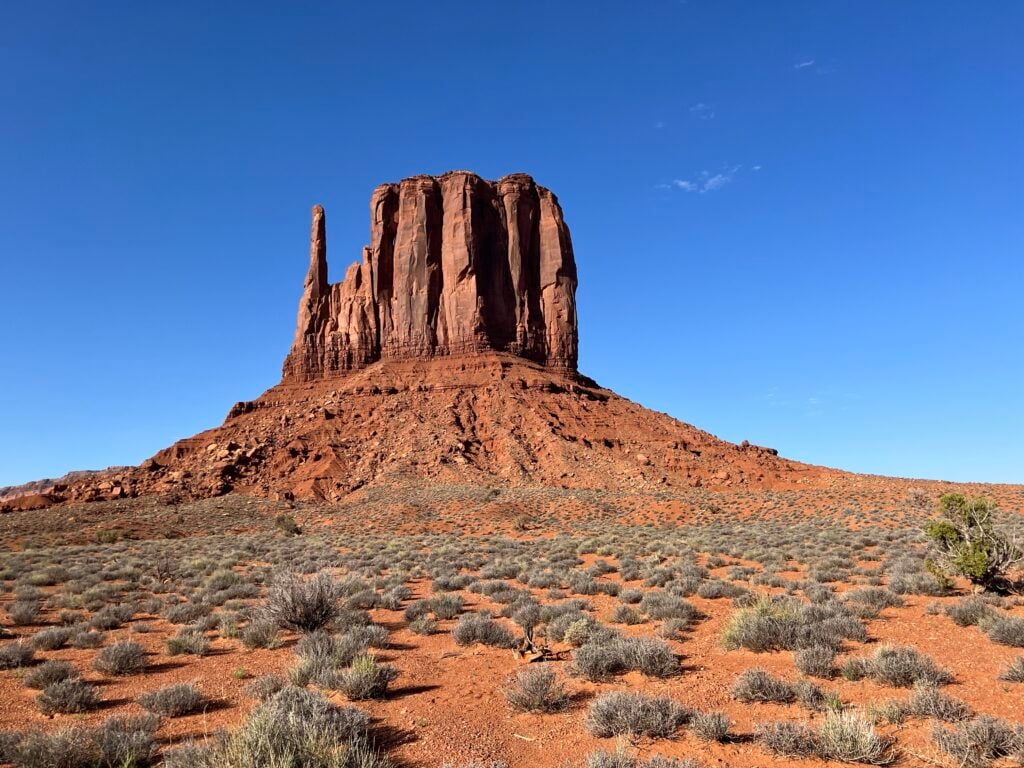
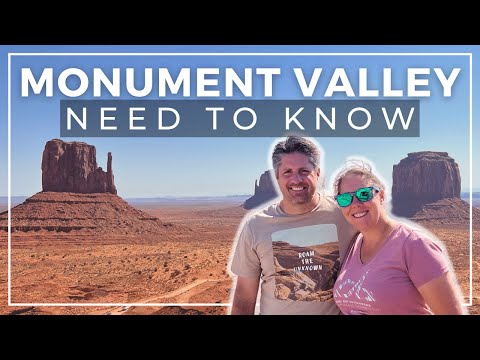
Monument Valley is a small park with one entrance road, one self-guided scenic loop drive, one self-guided hike, and one restaurant. The View Hotel, the visitor center, and the Trading Post are all in one building. All these attractions are within walking distance of one another, and one parking lot serves the whole area.
You can do the Monument Valley Scenic Loop Drive in a couple of hours, but we think that you should stay the night so that you can see one of the best sunsets and sunrises you’ll see in your entire life (it’s my all-time favorite). I’ll give you a morning, afternoon, and evening plan, but do it in the order that makes sense for you.

TO AVOID CONFUSION: The official name of the area is Monument Valley Navajo Tribal Park, managed by the Navajo Nation. The main attraction, a scenic drive through the park, is known as the Monument Valley 17-Mile Loop Drive. For simplicity, in this blog post, we’ll refer to the entire area as Monument Valley and the scenic route as The Loop Drive.
Get our done‑for‑you, 1-4 day route with exact drives, maps, and must‑see stops so you don’t waste time in traffic or miss the best views.
Inside the guide:
*Step-by-step plan for Monument Valley + the most efficient driving routes to connect them
*Exact time frames and star ratings so you can make the best use of your time and money
*Includes other great spots like Valley of the Gods, Hovenweep, Fort Bluff, and more
*Best Friend Guarantee: Love it or get your money back
*Visiting more in the West? Save big $ and get guides for Utah’s parks and the Grand Canyon with our Grand Circle Bundle.
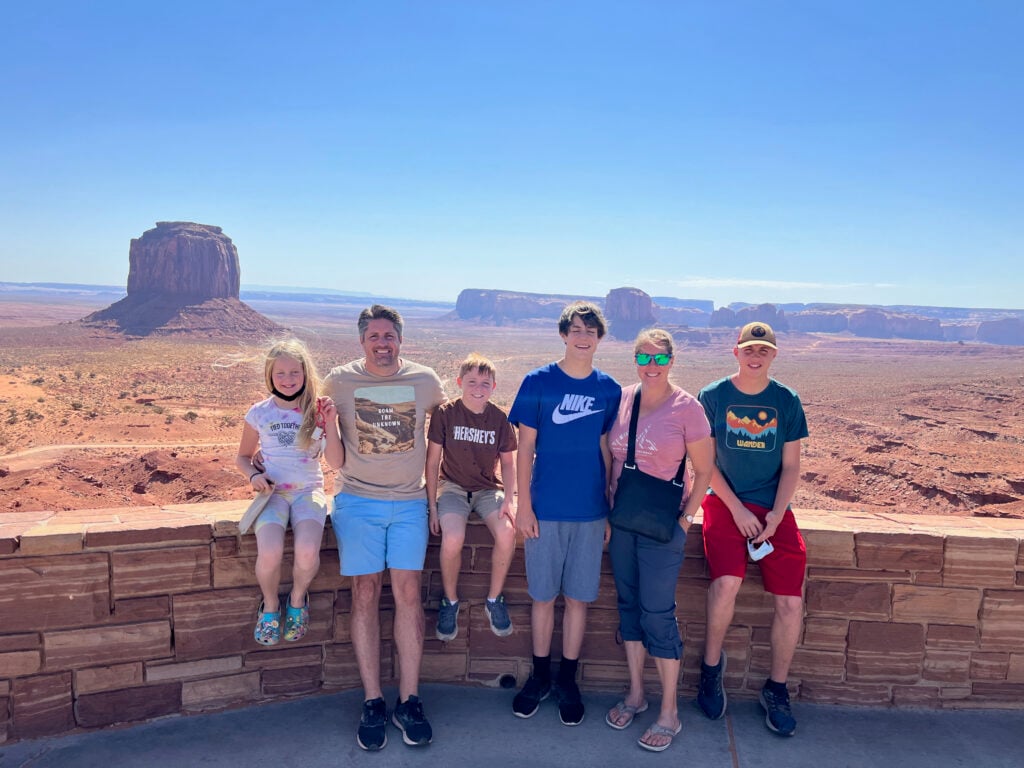
Stop #1: Watch a sunrise from the observation deck at the visitor center. It is the best place in the park to see it! You’ll see buttes, mittens, and expansive desert scenery. You may even see a wild horse roaming around. It really is magical!
After the sunrise, spend a few minutes checking out the displays inside the visitor center. There is also a Trading Post there that has all sorts of Navajo crafts. We bought a Kachina Warrior and love it.
Stop #2: Hike the Wildcat Trail. 4 miles round trip, easy. This trail will take you among the cool rock formations and you get to hike around East Mitten Butte. We enjoy a good desert hike in the morning and liked this hike. It’s important to know that the trail is exposed and really sandy. If you enjoy hiking, go for it. If you don’t, it’s ok to skip it. Remember, the best views of Monument Valley are from the observation deck at the visitor center.
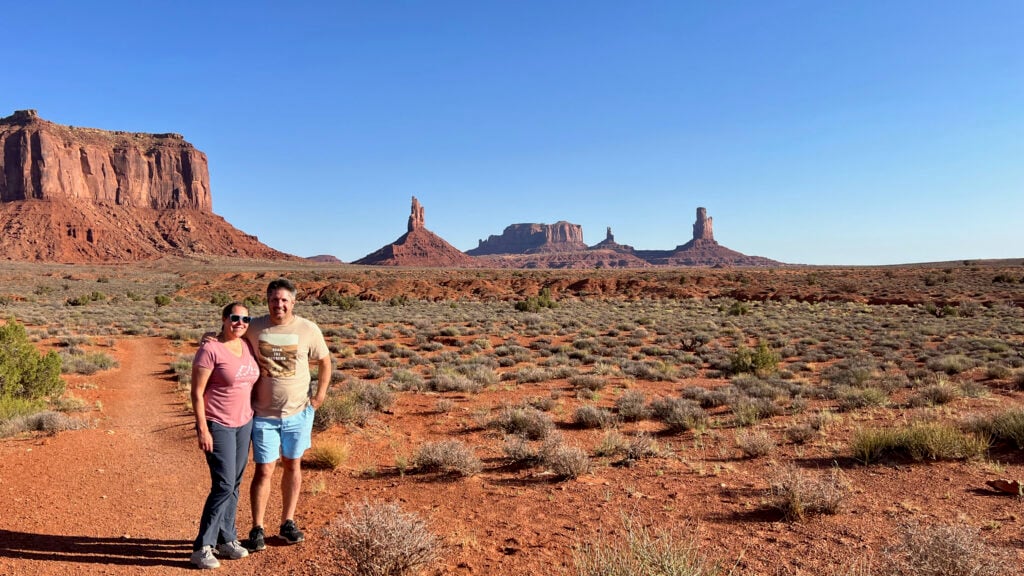
Stop #3: Loop Drive. Now you get to experience the reason you came to Monument Valley: to drive among the buttes and mittens on the 17-mile scenic drive. The scenery will not disappoint. It’s the most memorable activity to do here, and I can’t wait to drive it again.
Along the way, there are a few stops you can make. There are several spur roads that lead to viewpoints. They are all great! There are also a few roadside shops that sell souvenirs and snacks. The biggest stop is
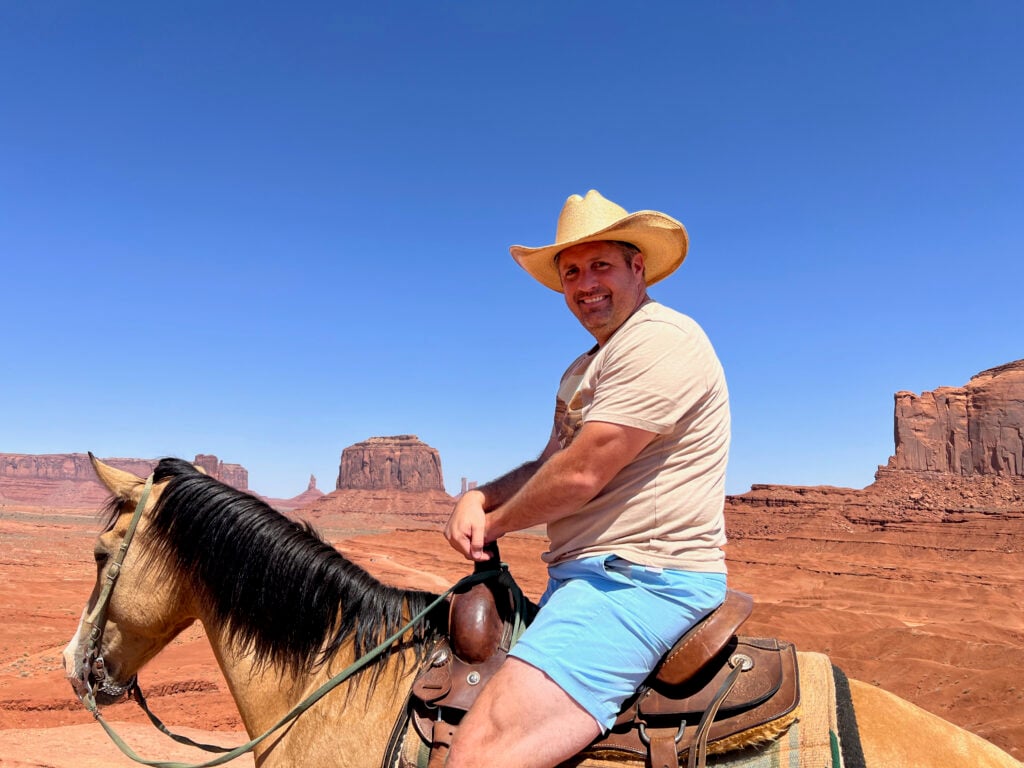
John Ford Point. This is a viewpoint named after the famed movie director, John Ford, who filmed several movies here. It’s a cool ledge to walk out on, providing great photo ops. You can pay $10 to get your photo taken on the horse named John Wayne Spirit. It’s certainly cheesy, but Matt just had to do it!
Stop #4: Monument Valley Tour. Monument Valley has some wonderful tours available. Jeep tours, horseback riding tours, photography tours, and cultural tours are all offered. These tours will take you on the Loop Drive but will also take you to places that visitors aren’t allowed to go without a tour.
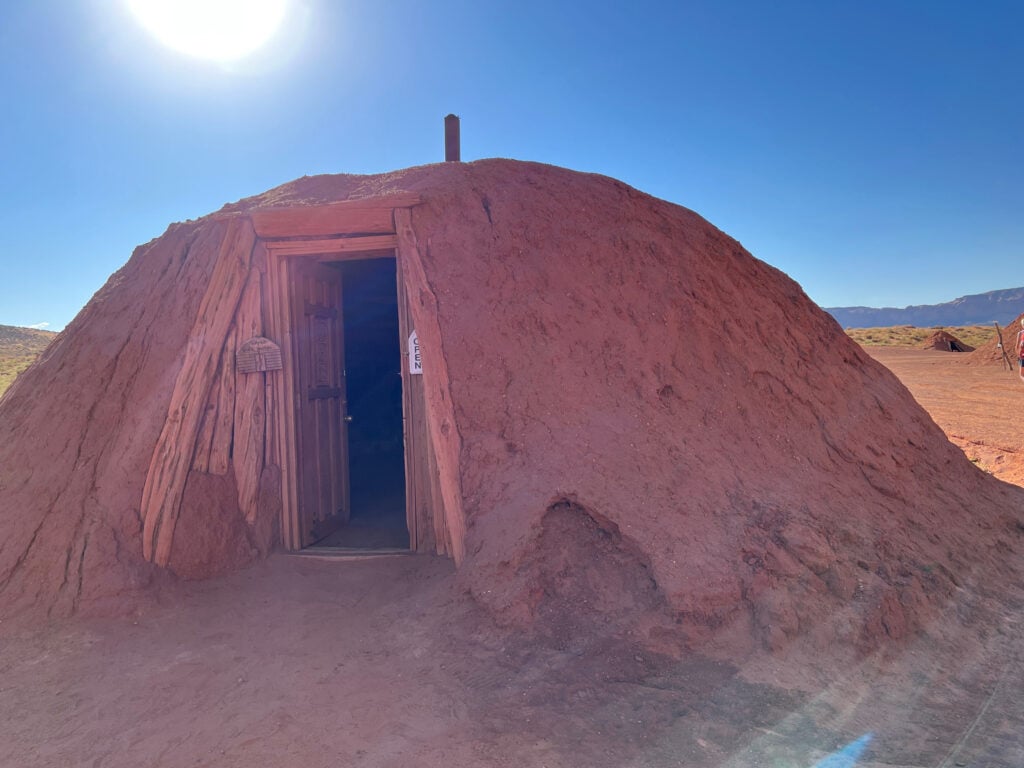
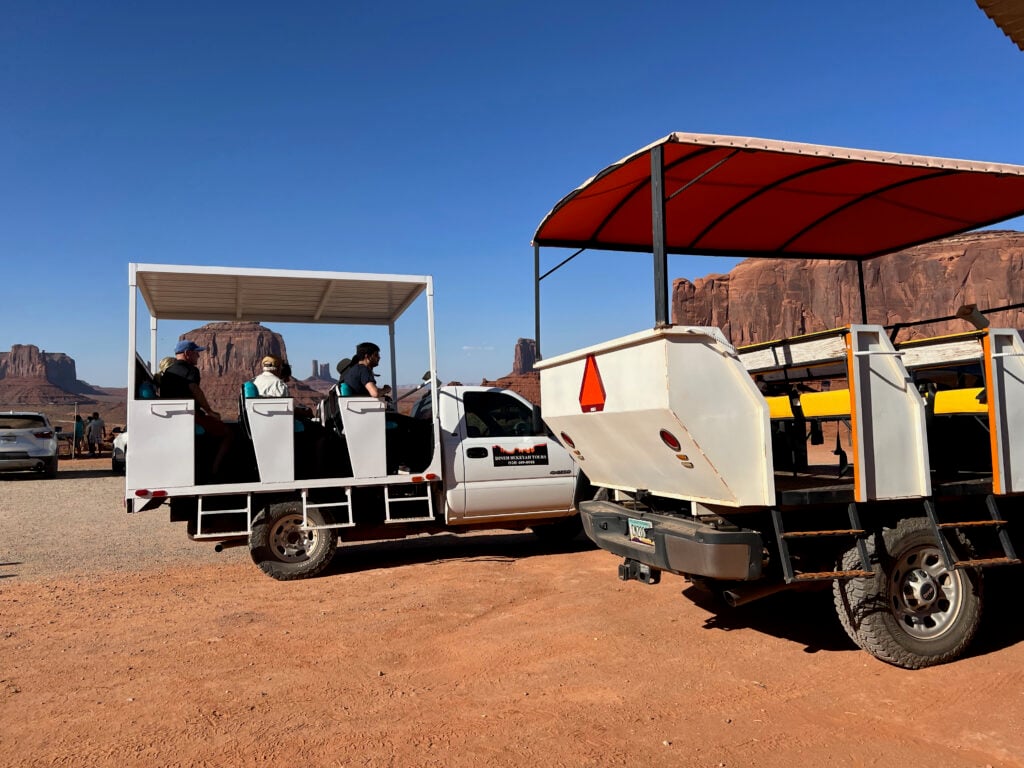
All tours are given by members of the Navajo Nation. You can book them on their website. We used Dineh Bekeyah Tours and had a wonderful experience (we paid for the tour on our dime- our opinions are our own!) We traveled in an open-air truck with really comfy seats (much smoother than when we drove it in our Sequoia). We saw arches and hidden coves along the way, and she took us to some special places, including a Navajo village with Hogans (mud houses). The highlight was when she took us to the Bird’s Eye (a cool rock formation) and played the flute for us.
DISCOVER: Driving in Monument Valley: 10 Things You Need to Know
Stop #5: Goulding’s Lodge is your next stop. This is outside the park, just 5 minutes from the park entrance. There is a free museum that has exhibits about the area’s filmmaking history. It’s fun to see all the different movies filmed here and pictures of famous actors. There is also a building called the John Wayne Cabin. It’s not named that because he stayed there. It was featured in one of his movies as his home. You can walk inside to learn about it.
GOOD TO KNOW: You can grab a Navajo Taco (Indian frybread) from the Stagecoach Restaurant onsite if you are hungry (but we like them better at the San Juan Cafe in Mexican Hat).
Stop #6: Forrest Gump Viewpoint. This is the famous spot where Forrest Gump (Tom Hanks) decides he’s finally done running and starts to walk home in the movie Forrest Gump. As you drive on Highway 163, signs mark the location of the viewpoint, with a pullout for parking. Be careful here as both a driver and photographer – people run into the road to get that famous picture.
Stop #7: The big thing to do tonight is to watch a sunset. The next activities listed are optional and may be better to do on your way into or out of the park. Check the sunset times and make sure you are back half an hour before the sun sets so you have time to enjoy.
Stop #8: San Juan Cafe. Drive 30 minutes north to Mexican Hat, UT, where you can get the BEST Navajo Taco in the area. It has great views of the San Juan River, too.

FUN FACT: The town of Mexican Hat gets its name from a sombrero-shaped rock formation on the edge of town. The rock formation is 60 feet wide and perfectly balanced.
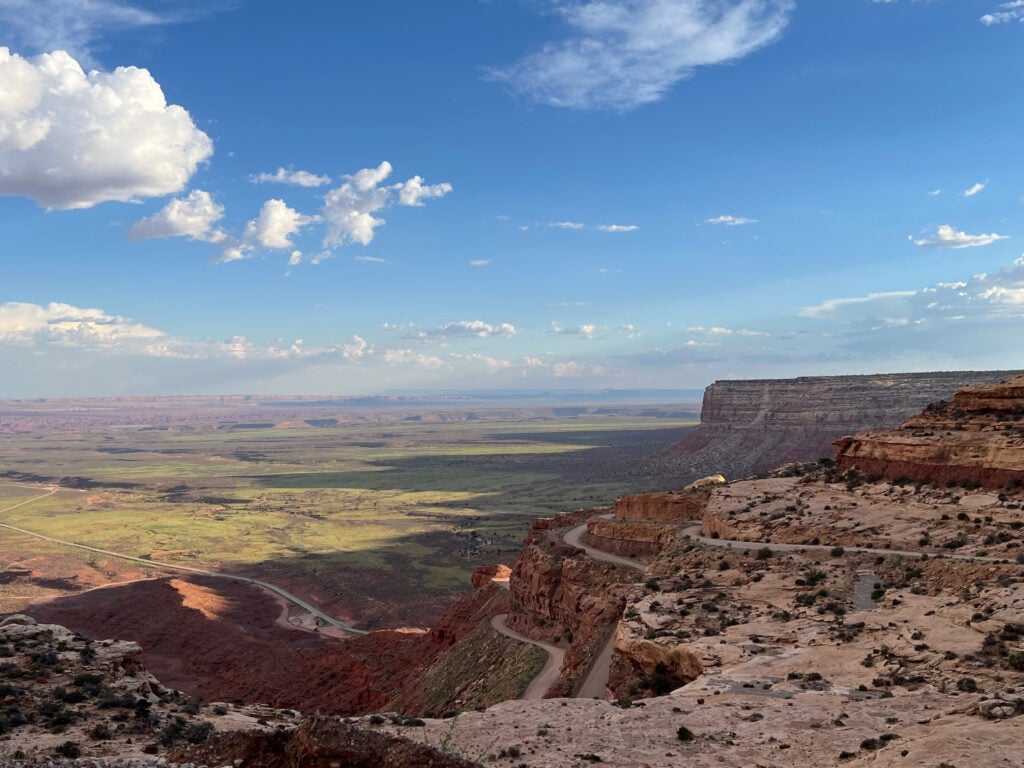
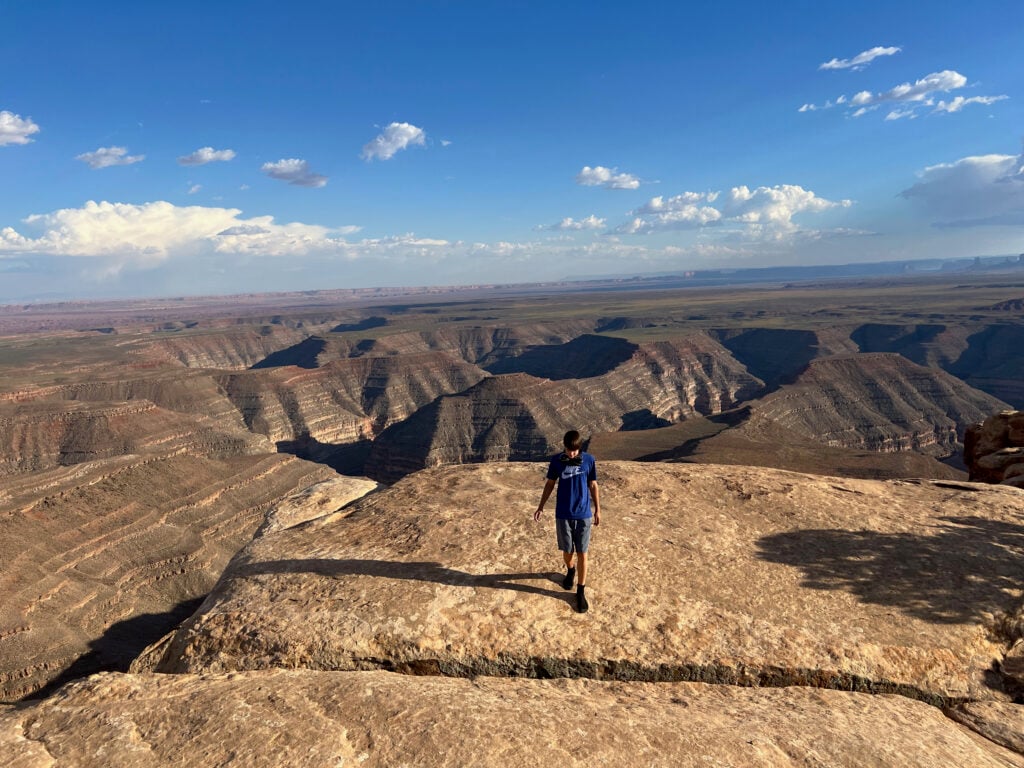
Muley Point Overlook. This is seriously one of the best overlooks we’ve ever seen. You’ll see Monument Valley far in the distance and a spectacular winding canyon right in front of you. The landscape is surprisingly green, at least when we visited (September). It’s about 35 minutes northwest of Mexican Hat. To get there, take Route 163 North and up the Moki Dugway (these are some awesome switchbacks with great views), and drive on a dirt road (it should be passable for cars). There are actually two viewpoints – we thought the second one was a little better. Just keep driving to the end, and you can’t miss it.
Sunset. We are sure that Muley Point would be an awesome sunset spot, but our favorite is just the observation deck at the visitor center. Other good options include the deck and dining room at the View Hotel (go for the views, not the food).
Get our done‑for‑you, 11‑17 day route with exact drives, maps, and must‑see stops so you don’t waste time in traffic or miss the best views.
Inside the guide:
*Day‑by‑day plan for the Grand Canyon, Utah’s Parks, and
Monument Valley
*Exact times, routes, and photo stops
*Includes audio stories to listen to as you drive
*Best Friend Guarantee: Love it or get your money back
You can do these on your way into or out of Monument Valley. They are all wonderful and we hope you have time to check them out.
You can also check out Valley of the Gods. It has views similar to Monument Valley and is also 17 miles long and will take you about an hour to drive. Make sure you have 4-wheel drive to do this because parts of this road are really rough.
You may also want to check out Goosenecks State Park. It’s a viewpoint that will take you no more than 30 minutes, but it gives you a great view of the San Juan River snaking back and forth. It’s over 6 miles of river that covers 1.5 miles of land. It’s so curvy and cool! It’s a $5 day fee you can pay online or in person.
Navajo National Monument. It’s an hour outside the park, a short detour if you are coming from or heading to Page, AZ. This is a wonderful national park site preserving ancient cliff dwellings built by the Ancestral Puebloans. These are some of the best-preserved cliff dwellings in the Southwest. The monument features three main ruins: Betatakin, Keet Seel, and Inscription House, though only Betatakin and Keet Seel are accessible to visitors. Read more at How to Visit the Cliff Dwellings at Navajo National Monument.
Bluff Fort Historic Site is a free living history fort honoring the Hole in the Wall Pioneers who had to cut their own trail (and lower wagons from a hole in the wall) to settle this area. The trek was supposed to take 6 weeks, and it took 6 months! All 200 members lived and you can learn their story from the fun and interactive video they show inside. Homemade woodcrafts, quilts, and cookies are a nice touch, and the waterwheel, cabins, and stagecoach outback are great. Plan around 2 hours and… it’s free!


WANT MORE INFO: Check out our blog post, One Day in Monument Valley
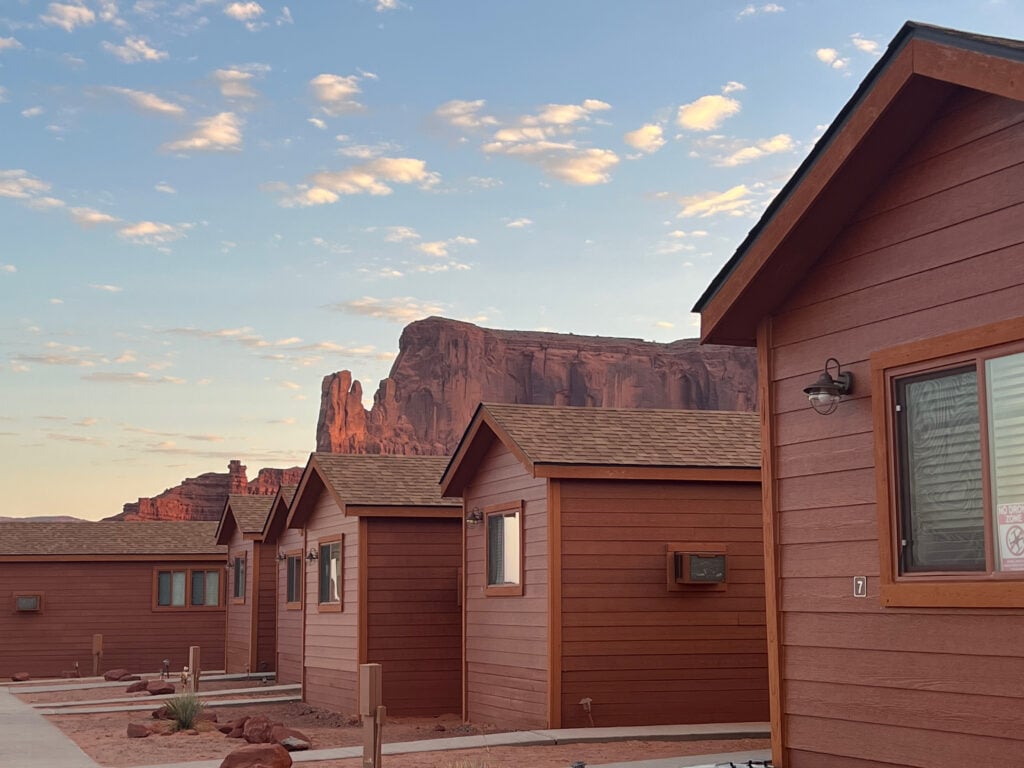
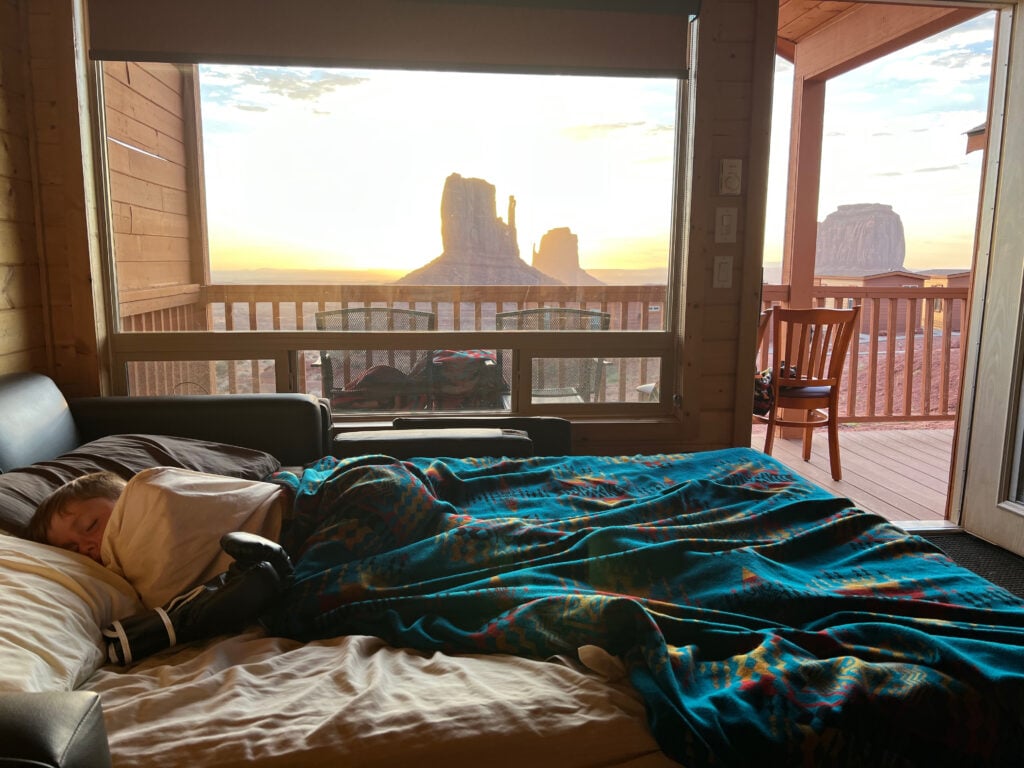
Sleep. If you can, stay at The View Hotel or Cabins. You have incredible views from your room. It’s within walking distance to everything in the park. We stayed in the cabins and loved it. One of my favorite memories was waking up in the morning and sitting on our private deck to watch the sunrise. Our cabin also had a full kitchen, so we could prepare our own food. It was a bit pricey ~$300 a night, but it was worth it. You can book your stay at monumentvalleyview.com. They also have an RV park.
Get our done‑for‑you, 7‑14 day route with exact drives, maps, and must‑see stops
so you don’t waste time in traffic or miss the best views
*Day‑by‑day plans for Colorado’s national parks and mountain towns
*Details you need: Best activities, hikes, drives, and where to sleep each night to reduce backtracking
*Best Friend Guarantee: Love it or get your money back
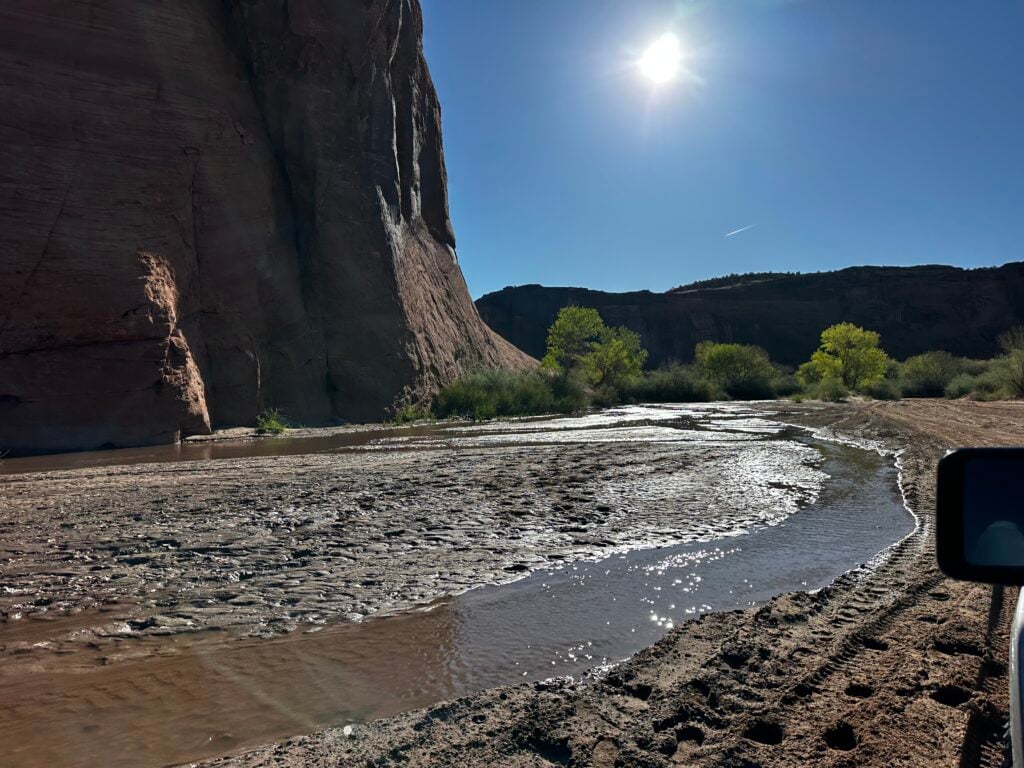

Four Corners Monument is probably the least cool thing on this trip, but you have to do it because nowhere else can you be in four states at one time- plus it’s a fun photo! But you’ll want to spend the majority of your day in Canyon de Chelly, where you will see beautiful canyons, cliff dwellings, and petroglyphs. Both are on Navajo Tribal Land, so be prepared with both cash and a credit card.
It’s about a 4-hour drive from Monument Valley to Canyon de Chelly, so you may want to skip Four Corners Monument, plan an extra day, or do some of Canyon de Chelly in the morning on day 3.
Stop #1: Four Corners Monument. This should take you no more than an hour. It will cost you around $8 per person and is on Navajo Tribal Land. It’s mostly just a flat, cement monument that has four corners meeting in the middle, with each of the states written on them. There are also several flags representing the states and tribe, as well as some Navajo-run shops.
Take a couple of fun pics, grab some fry bread, and maybe some jewelry too, and then be on your way!
Stop #2: Canyon de Chelly
There are two canyons: Canyon de Chelly (South Rim) and Muerto Canyon (North Rim). The North Rim has three overlooks and you can easily drive this in 30 minutes. We recommend checking them all out, but here’s a brief description of each in case you only want to stop at a few.
Optional Stop: Head over to the Canyon de Chelly Welcome Center. It’s just a 15-30 minute stop where you can ask questions, see what ranger programs are going on, pick up a souvenir (Matt bought a t-shirt!), fill up on water, use the flushing toilets, and watch the 22-minute movie.
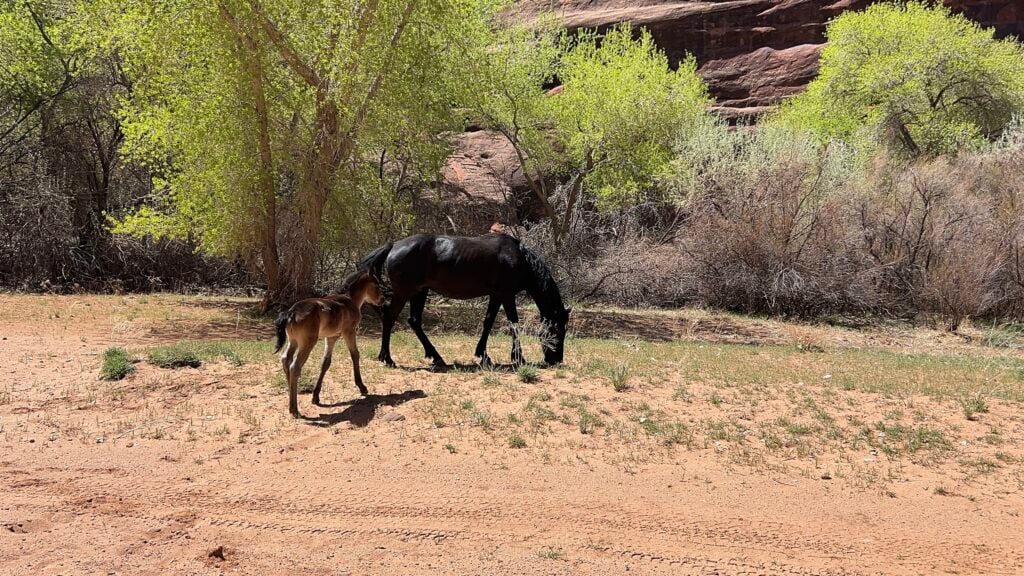
SOMETHING SPECIAL: You will see wild horses all over this area, both along the rims as well as at the bottom of the canyon. When we were there in the spring, we saw several colts. Adorable!
Stop #3: Go on a Guided Tour to the bottom of the Canyon. Because this is located on Navajo land, the Navajo Nation makes the rules. Visitors must book a tour and visit the bottom of the canyon. Tours can range from 4 hours to a full day. You can book a group tour or a private tour as well. Rates range from $90-$365 per person and are available from the Thunderbird Resort or from Canyon de Chelly Tours. These are given in open-air trucks or jeeps with 4-wheel drive because they drive along the wash at the bottom of the canyon.
We did the 4-hour private tour with Canyon de Chelly Tours, which we thought was the perfect amount of time. It was $200 per person, which was pretty steep, but we really enjoyed our experience. We booked our tour in advance, but same-day tours were available.
Our tour included up-close views of the cliff dwellings that we had been viewing from the canyon above with binoculars. We also saw some of the best petroglyphs we had ever seen.
Three things made this tour incredibly special and memorable.

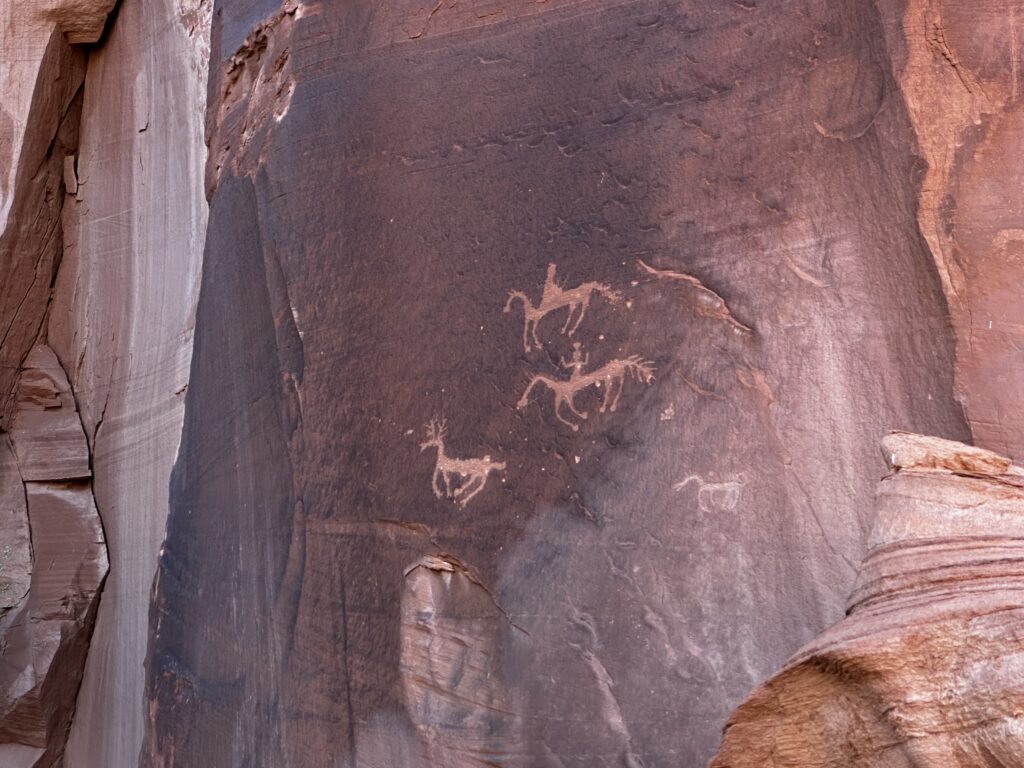
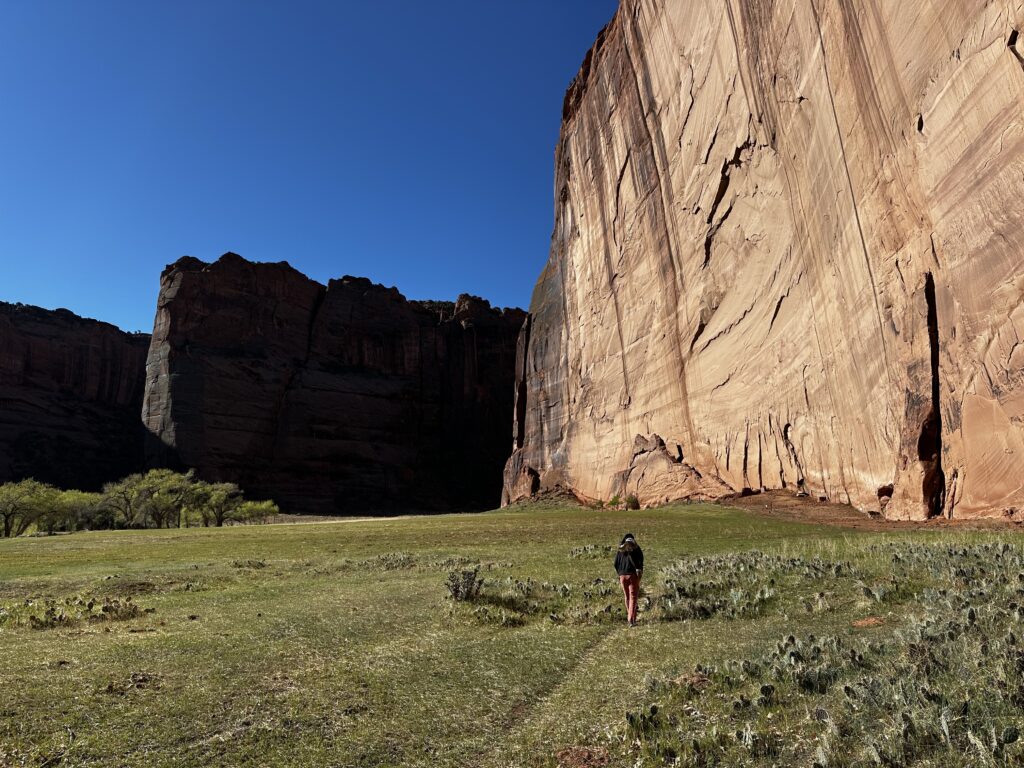
Stop #4: Drive the South Rim at Sunset
Look up what time the sun will set. You will want to arrive at your final destination, Spider Rock, 45 minutes before the sun goes down. It will probably take you around an hour to get there because there are so many great overlooks along the way. Some of the viewpoints are accessible, but even the ones that aren’t are pretty easy to walk to. We did all of them and it was a wonderful experience. We recommend doing the same!
Sleep. You can stay at the Thunderbird Lodge within Canyon de Chelly or the town of Chinle, AZ, just 5 minutes away. The Thunderbird Lodge (book here) was ok, but I would have preferred to stay in a chain hotel in Chinle. For more about where to stay and eat, as well as more details of how to visit Canyon De Chelly, check out our blog post How to Visit Canyon De Chelly National Monument: One-Day Itinerary.
My guess is that you may need the morning today to finish seeing Canyon de Chelly. We think this is one of the best stops on this trip, so make sure you give it proper attention. Plus, you have a 2.5-hour drive to Holbrook, AZ, where you will want to sleep tonight.
The Hubbell Trading Post National Historic Site was established to assist the Navajo with trade after they were able to return to their land after the Long Walk. It’s a nice stop, but you have our permission to skip it if you are short on time.
You’ll end your day in Holbrook, AZ, a Route 66 town with fun dinosaur statues, gift shops, and a good place to eat.
Stop #1: Hubbell Trading Post. This is only 40 minutes away from Canyon de Chelly and is an interesting historic site, and it only took us about 45 minutes to see all of it, though you could probably stretch it to an hour and a half if you wanted to do everything.
Check out the visitor center that has exhibits about the Hubbell family, who set this whole thing up, as well as learn about the return of the Navajo.
There is a fun general store with a wooden boardwalk surrounding it and wooden floors that make you feel like you are back in the Old West. Cookware, food, and goods are on the shelves behind the counter, just like they would have been over 100 years ago. You can buy a snack here if you want.
They also have a jewelry and rug shop where you can purchase crafts made by the Navajo people. When we were there, a woman was weaving a rug, and it was cool to watch.
Outside, there are some old farming tools as well as some farm animals to check out.


Stop #2: Holbrook, AZ.
This is an old Route 66 town and several of the stores pay homage to their history. I have never seen so many dinosaur statues (which I loved!) and there are petrified wood gift shops everywhere. One thing that really surprised me was that there was a petrified wood quarry just out in the open with petrified wood all over the ground. It would be so easy for people to steal it, but it didn’t seem to be a problem.
Grab lunch/ or early dinner at Studio 66 Cafe. They have legendary loaded fries. Matt tried the Lawless Buffalo Blevins (Buffalo chicken strips + pepperjack + green onions) and I tried the Route 66 Dog with peppers, onion, and bacon. Pretty good! They also specialize in treats like ice cream, drinks, and baked goods.
Sleep. There are a few places to stay here and you’ll be nice and close to the Petrified Forest (where you are heading tomorrow). We stayed at the Wigwam Motel, which is where they got the inspiration for the Cozy Cone Motel from the movie Cars. It was kind of old but serviceable and actually pretty fun!

Petrified Forest National Park is 30 minutes away from Holbrook and has tons of petrified trees and very cool sand dunes that are pink, red, orange, white, and blue! They are called the Painted Desert. This park will take you most of the day to do everything, or you can see it in just a couple of hours if you are in a hurry. The nice thing about this park is that it is a drive-through park (north off I-40, south off Hwy 180), connected by a 28-mile scenic road, which means you can exit from a different entrance than where you entered the park, saving driving time to your next destination.
It’s pet-friendly, offers short walks, scenic viewpoints, and a few historic stops.
Stop #1: Petrified Forest Museum. This is on the way into the park from the West side and it’s a gift shop, not part of the NPS. But… It’s the best spot to pick up a souvenir if you want one. There is petrified wood, cool rocks, T-shirts, and other trinkets. Better prices and more selection than what you will find inside the park.
Stop #2: Rainbow Forest Visitor Center. There are actually two visitor centers here (one at both ends of the park). I think this is the best of the two. There are some nice displays inside about the petrified trees and wildlife, and you can watch a movie in the adjacent building. Out back is the Giant Logs Trail that only takes 30 minutes, but we think that there are better trails out there, so we recommend skipping this one.
You can also pick up some bottled water and snacks in the same building where the movie is. Restrooms (with flushing toilets) and water refill stations are available in the visitor center
Stop #3: Agate House and Long Logs Trail. This is a long, hot walk, but it is worth it (1.6-2.8 miles). Most of the trail is smoothly paved. At the end, you reach two petrified wood structures built 700 years ago called the Agate House. Hundreds of similar ruins in the park, but this is the only place we found them, and they were so cool.
Since you are already out there, you can add another mini loop to your hike to experience the Long Logs Trail, which has some of the longest petrified trees in the park.
Stop #4: Crystal Forest Trail. 0.7-mile loop, paved. It is stroller-friendly and has colorful petrified logs and bluish-purple mounds of sand. We think the name is a bit misleading—no forest, no crystals. But we think it’s the best trail in the park to look at petrified wood.
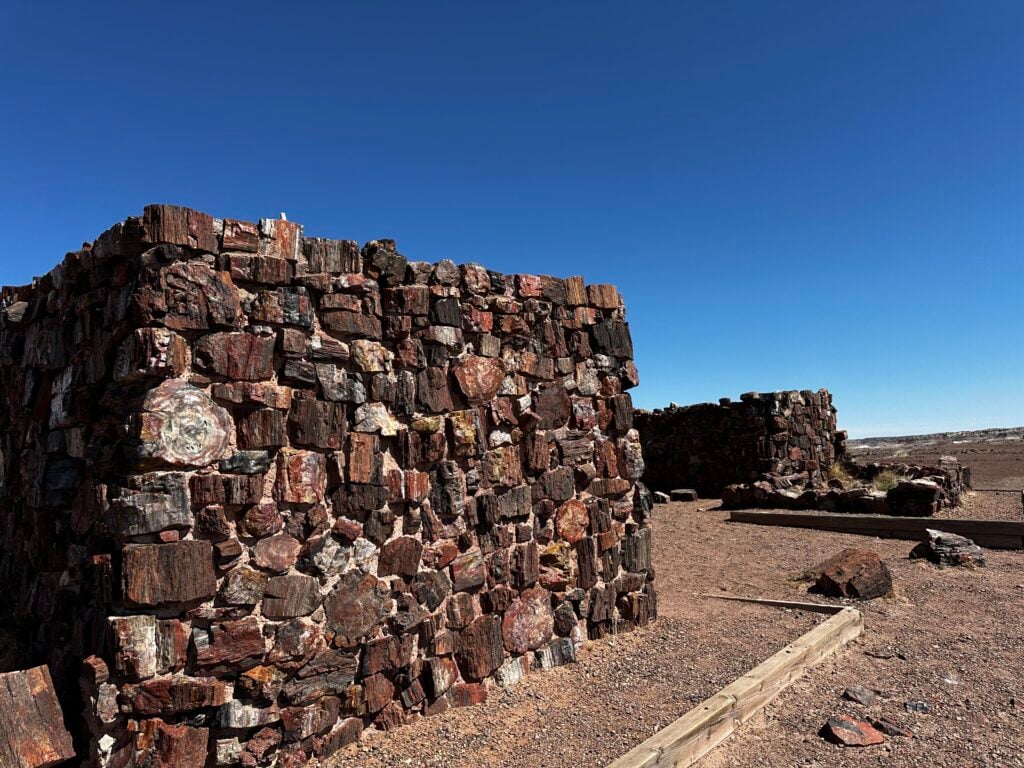
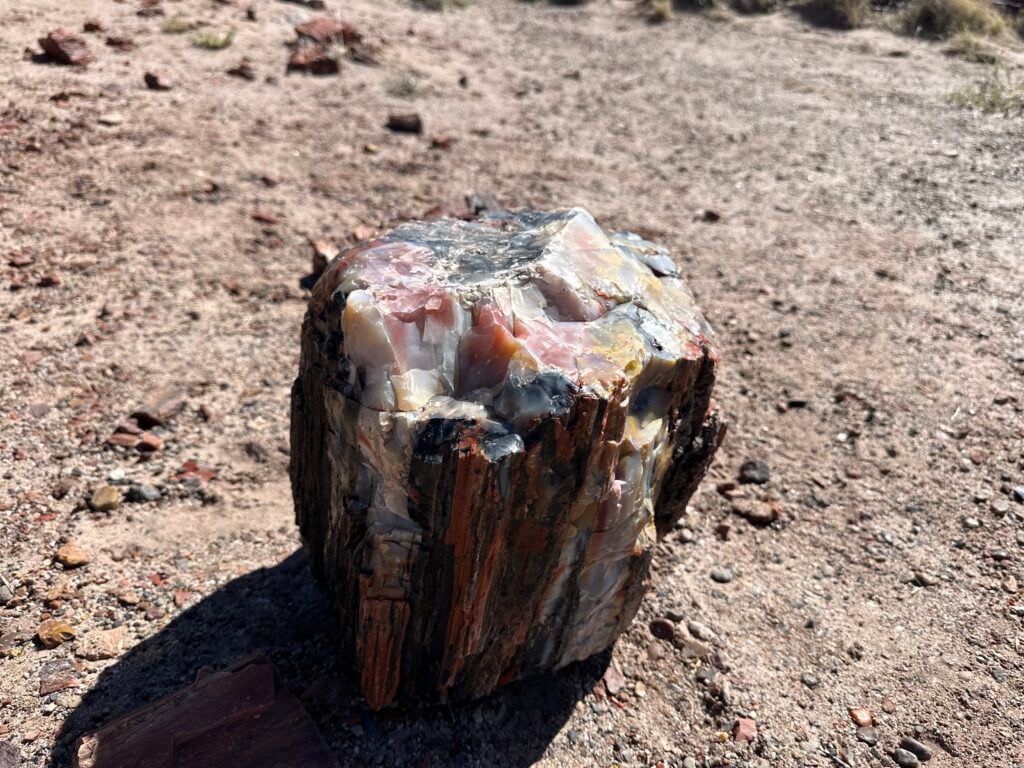

Stop #5: Blue Mesa Trail. 1-mile paved loop through purple badlands. A bit steep and not wheelchair accessible, but it’s our favorite hike in the park. The trail weaves in and around the purple, blue, and white sandhills. It’s unique and beautiful (though a rough climb out). If you aren’t a hiker, there are some pretty viewpoints from above that you can enjoy.
Stop #6: Route 66 Stop. This is mostly a photo op with a rusty Jalopy, but the interstate is visible in the background and it’s a powerful image of how the highway bypassed this area.
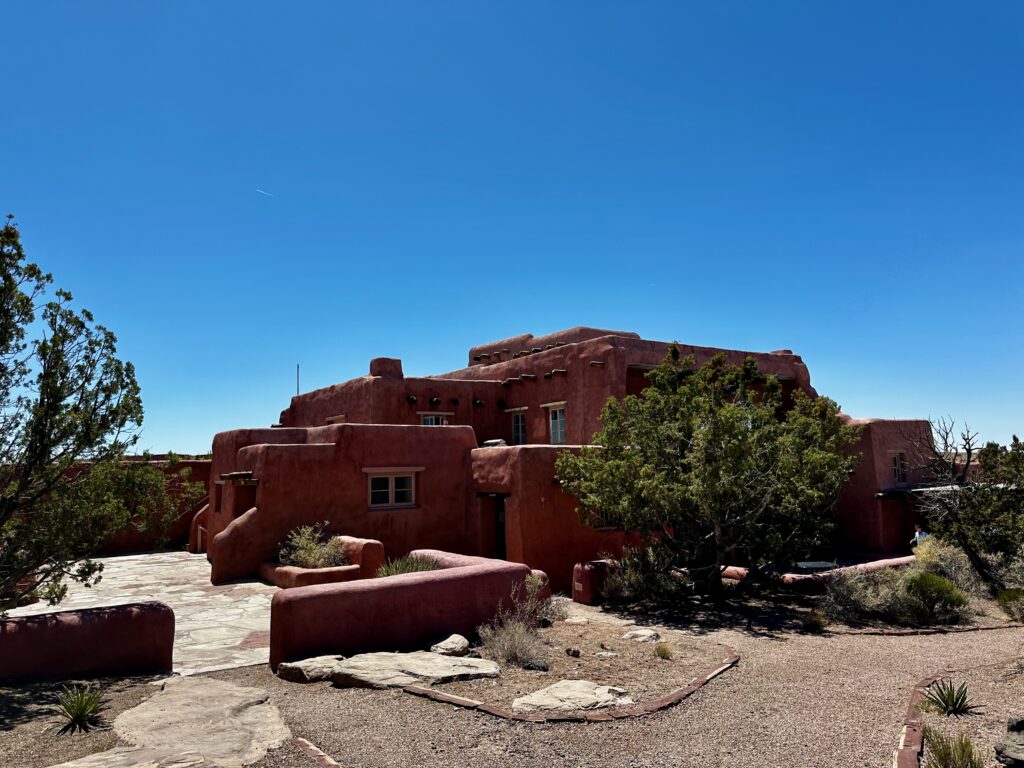
Stop #7: Painted Desert Inn & Kachina Point. This is a Historic Route 66-era inn, now a museum. Features murals by Hopi artist Fred Kabotie. Amazing views and short walks. An ice cream parlor is open in summer. You also have more views of the “painted sand dunes,” but these ones are red, pink, orange, and yellow.
Sleep: We slept in Gallup, New Mexico, at the El Rancho Hotel (book here). Old Western stars like John Wayne and Ronald Reagan would stay here when they were filming. The hotel has been recently renovated, is clean, affordable, and a fun place to stay. Highly recommend!
For more details on how to visit Petrified Forest National Park, read our blog post One Perfect Day in Petrified Forest National Park.
13 road trip ideas across the West so you know where to go, how long to stay, and what to see
*Sample routes from 4–31 days across national parks and hidden gems
*Driving times + best stops so you don’t miss the good stuff
*Season + weather notes to avoid closed roads and peak‑crowd days
*Lodging ideas in the right spots so you cut backtracking
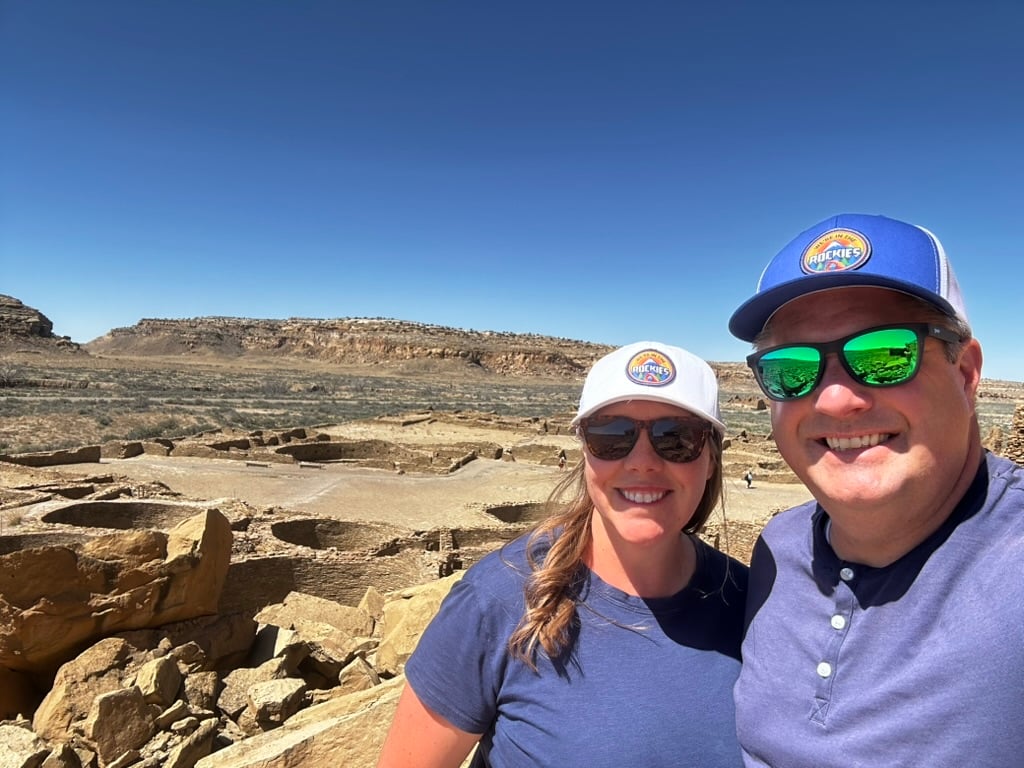
Chaco Culture National Historic Park can be visited in one day and contains amazing remnants of the Puebloan people. There are 6 great houses visitors can explore; the main highlight is Pueblo Bonito, where guests can view it from above as well as actually walk through the structure! It has over 700 rooms and is the biggest ruin in North America!
It’s a 95-mile, 2.5-3 hour drive from Gallup, NM. Much of this road is dirt and bumpy, but it’s worth it! The park has limited services and guests should pack a picnic and fill up on gas before entering the park.
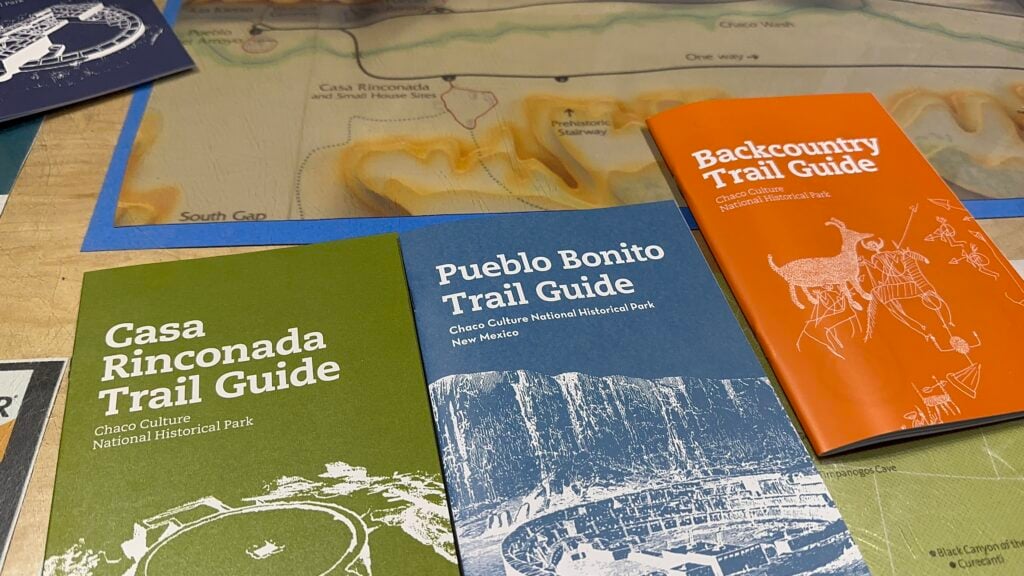
Stop #1: Chaco Canyon Visitor Center. It has clean, flushing toilets, water refill stations, and a gift shop where you can buy $2-3 trail guides for each of the major stops. These are really important because the ruins do not have signs explaining what you are seeing.
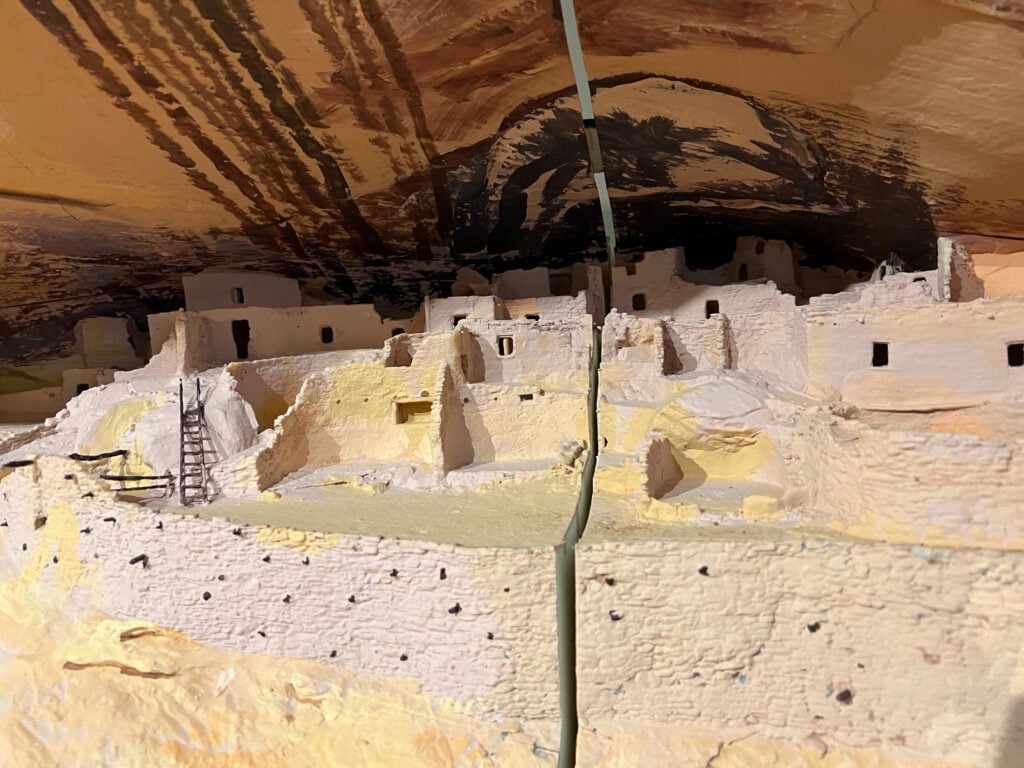
The exhibits are well done, including a light-up diorama of Pueblo Bonito. There’s also a park movie, though it wasn’t working during our visit.
Stop #2: Chetro Ketl. This site shares a parking lot with Pueblo Bonito and the Petroglyph Trail. This was the largest Puebloan site we’d ever seen (until we walked around Pueblo Bonito, coming up soon) — massive walls, dozens of rooms, and tall structures that once reached 3 to 4 stories high. It took around an hour to walk the site. The kiva was so large that wooden pillars were needed to support the roof, which wasn’t possible with logs alone.
Stop #3: Pueblo Bonito. This is the highlight of Chaco Canyon — and one of the most incredible archaeological sites in the U.S. Pueblo Bonito contains over 100 rooms and dozens of kivas, and it was built more than 900 years ago. It took 300 years to complete.
The trail to the ruins is flat and gravel, but not accessible. People were using walking sticks to navigate the stairs and uneven ground. You start by walking around the perimeter, and then suddenly you actually get to enter it! You’ll walk through room after room, some with low doorways that require stooping. It’s easy to get disoriented, which only adds to the feeling of stepping into another world.
Some walls are wider at the base than the top because they were intentionally built to support multiple stories, possibly four. One part of the structure was destroyed by a rock slide, but what remains is breathtaking.
There are a few areas roped off and no guardrails. You have to look out for your own safety. But the lack of all the safety measures and signage allows you to feel more connected to the site and experience it more like the people did 1,000 years ago.
We spent at least two hours exploring here and it was our favorite stop in the park.


Stop #4: Pueblo Alto Overlook. If you have more energy, climb up to an overlook for an aerial view of Pueblo Bonito. It’s a great way to grasp its scale and placement within the canyon. The hike is fun too! It’s 2 miles round trip, exposed, and the beginning of it is challenging.
Sleep: Although there is a campground in Chaco Canyon, most people choose to stay outside the park. You can stay in Albuquerque (3 hours away), Gallup (2 hours away- stay at the El Rancho Hotel (book here)- all the movie stars from old Western movies used to stay here), or Farmington (1.5 hours away; stay at the Casa Blanca Inn & Suites (book here)- delightful!)
We packed our own picnic and there are grocery stores in all of these towns. For a good meal in Farmington, check out Joe’s Italian Restaurant.
For more details on how to visit Chaco Culture Historic Park, read our blog post How to Visit Chaco Culture National Historic Park: One Day Guide.
Today is a great mixture of national monuments with ancient ruins. You’ll end your day at Mesa Verde National Park, one of the best stops on the trip, where you will see ancient cliff dwellings hugging the walls of the canyon.
Stop #1: Aztec Ruins National Monument. This awesome site is right in Farmington, NM, so you won’t have much of a drive at all to get to it. What is super cool about this place is that 1) they have recreated a kiva, including adding a roof and inserting artifacts to make it look more like what it would have looked like when it was being used and 2) a great (and free audio) guide is available to teach you more about these fascinating structures and people!
We did this whole stop in 15 minutes, but I could have easily spent an hour here, really taking it all in.
Stop #2: Hovenweep National Historic Monument. You’ve got a 70-mile, 1 hr 45 min drive to Hovenweep, where you will see even more ancient structures. I know it sounds like looking at all these ancient ruins would get old, but each site is different enough that they are all worth seeing and interesting!

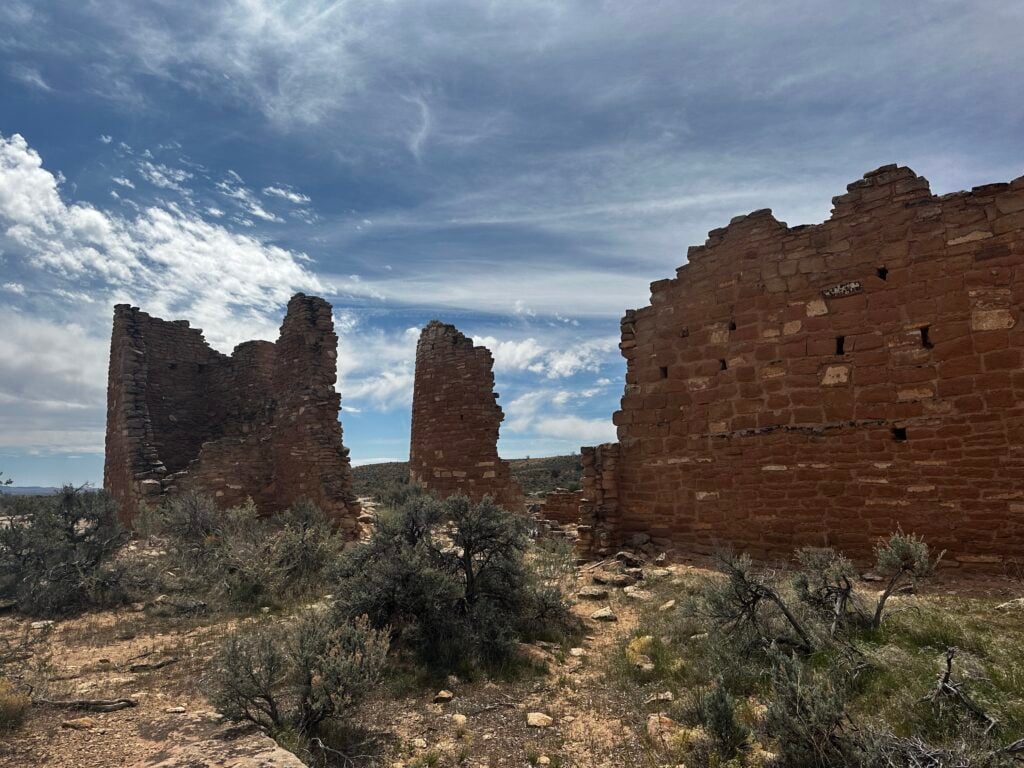
Hovenweep preserves six prehistoric villages built by the Ancestral Puebloans between A.D. 1200 and 1300. Its stone towers, many perched dramatically on canyon rims and balanced on boulders, are awesome! It feels remote and untouched, offering visitors a quieter, more intimate experience.
You can view the best of the park in just a couple of hours. Stop in at the visitor center to use the flushing toilets and refill your water bottle. Head out back to the Square Tower Group Loop. This 1.5-2 mile loop hike is going to take you to see the very best of Hovenweep! It will take most people 1.5 hours, and I rate it a moderate hike because you have to climb in and out of the canyon at one point. The rest of the trail is flat and easy. Here are what we think are the best sites along the trail.
Sleep: Drive 42 miles (1 hr) to Cortez, Colorado and spend the night. There is also a lodge and campground within Mesa Verde National Park.
For more details on how to visit Hovenweep National Historic Monument, read our blog post How to Visit Hovenweep National Monument: One Day Itinerary.

My husband thinks Mesa Verde is the most underrated national park. It provides incredible historical Indian cliff dwellings, unusual hiking and scrambling experiences to enjoy the ruins (you get to go in them!), great scenery, and a nice little scenic drive. It’s a perfect one-day park. If you really wanted to see more dwellings, you could certainly spend another day, but we think one is enough.
There is only one exit/entrance and the park is divided into a few sections. We don’t believe you need to visit all of them. Here are our favorite stops.
Stop #1: Scenic Drive. You’ll have to do this whether you want to or not because it is how you access other areas of the park. It’s full of twists and turns and has great canyon views. Drive for an hour until you get to Chapin Mesa.
Stop #2: Mesa Top Loop. This is a section within Chapin Mesa. There are several stops along this drive where you can see ancient structures. This is optional, especially if you have a tour booked, but it gives you plenty of opportunities to see and learn about the ruins and people of this region. This could take a couple of hours, depending on how many stops you make (there are at least 10 sites).
Stop #3: Cliff Palace Loop. This is also a section within Chapin Mesa, and it’s our favorite part of Mesa Verde because you can book a guided tour where you actually get to go INTO the cliff dwellings. We love the following two tours.
ABOUT TOURS
Stop #4: Grab Something to Eat. Indian frybread is usually sold near Balcony House. Give it a try. If you want a finer dining experience, try the Metate Room Restaurant at the Far View Lodge, which has excellent views of the canyon.
Sleep: You can spend another night in Cortez, or if you are up for even more adventure, you can head toward Durango, Colorado, for even more fun! It’s just 36 miles (45 minutes away).
For more details on how to visit Mesa Verde National Park, read our blog post How to Visit Mesa Verde National Park (1-Day Itinerary + Where to Stay and Eat).
–When to Start Your Day: In general, crowds are not an issue when visiting these parks. Parking shouldn’t be an issue, so there is no need to be at the park at a certain time.
–What to Wear: Dealing with the sun and heat in this area is a major concern. Make sure to wear a wide-brimmed hat, sunscreen, sunglasses, and even a sunshirt. Although you can hike on this trip, most of the trails and walks are easy and a sturdy pair of trail-running shoes should be comfortable and supportive. Check out our recommended gear.
–What to Bring: A good water bottle or CamelBak if you are hiking. We love having binoculars for the viewpoints.
–Road Conditions: While most roads are paved, you do come across bumpy dirt roads fairly often. We highly recommend a high-clearance, four-wheel drive for this trip. If rain is in the forecast, check with a ranger before attempting dirt roads.
–Cell Phone Service: Your cell phone service will come and go throughout this trip and it’s best to have printed maps, extra water, and know how to change a tire.
–Services Within the Parks: Water spigots, flushing toilets, and gift shops are available at all the visitor centers. Most of the parks don’t have a place to eat, or if it does, it usually isn’t very good. We recommend packing a picnic lunch and dining in the gateway towns.
If you’re flying in for a Four Corners road trip, the best airports are Durango (DRO), Albuquerque (ABQ), Flagstaff (FLG), Salt Lake City (SLC), and Grand Junction (GJT). Durango is closest to Mesa Verde and Aztec Ruins, and is a great small airport to start from. Albuquerque is a major hub and works well if you’re visiting Chaco Canyon, Santa Fe, or Canyon de Chelly. Flagstaff puts you close to Monument Valley and northern Arizona sites. Salt Lake City is a good choice if you’re coming from farther away or want to include Utah’s national parks, though it’s a longer drive. Grand Junction is also an option if you want to start your loop in western Colorado. All of these work depending on where you want to start and end your route.
If you want to make planning your trip to Monument Valley a breeze, check out our easy-to-follow, step-by-step itinerary.
Itinerary includes:
Grand Canyon Beginner’s Guide: Itinerary + Lodging & Tips
Zion National Park Trip Planner
22 Absolute Best Things To Do in Kanab Utah (+ Where to Eat & Stay)
How Many Days to Visit Bryce Canyon: 1 & 2 Day Itinerary + Maps & Must-Sees
How Much Time Do I Need to Visit Capitol Reef National Park?
Perfect Itinerary for Arches, Canyonlands, and Moab (2-5 Days)