
Floating the Merced River is by far one of my favorite activities to do within Yosemite National Park.
This super scenic and relaxing activity is one of the best ways to see the valley floor, with the added bonus that it can be at no or low cost! This is the perfect addition to all itineraries and for all ages to spend half a day cooling off in the heat of the summer.
I’m Juliana, and I have floated the Merced a handful of times. In this post, I will help guide you on the best tips and tricks so you can plan the best possible float for you and your family on your next visit to Yosemite National Park!
Make your trip planning EASY, avoid the crowds, and see places most people don’t know about
Inside the guide:
*Step-by-step plan that will take you to the best hikes, viewpoints, drives, and must-do stops
*Exact time frames and star ratings so you can make the best use of your time and money
*Best Friend Guarantee: Love it or get your money back
*Stay in the right spot with our area recommendations to reduce time driving and waiting in entrance lines
The Merced River is very expansive, with only a small section being possible to float. The float-accessible stretch starts at Stoneman Bridge and ends at Sentinel Beach. These spots are the most popular because they are close to shuttle stops and take advantage of the entire floatable part of the river.
You can start or stop anywhere in between those two points, with plenty of beaches and shallow waters to begin or pull off of along the way.
The water levels fluctuate greatly throughout your float, but this section of the river is narrow, with you never being more than 10-15 feet from a shallow shoreline.

There are two main ways people choose to float the Merced. I have always brought my own float, which is what I highly recommend, but read on to decide what is best for your group’s needs.
This is best for those with mobility issues and/or younger kids. Every step of the way is planned out with plenty of people to assist your group as needed. These floats are not guided, so you will have the same freedom while floating, but all of the heavy lifting, such as transporting the raft, will be done for you. Having one big float for a group can also help keep track of everyone and is perfect for those who are not great swimmers.
It is good to know that you can only rent rafts, not tubes, unfortunately. If you want to let everyone have their own space or to be more spread out, attempt to rent a few rafts (minimum 2 people per raft) or opt to bring your own tubes instead.
You must go in person to the Curry Village Tour and Activity Kiosk. This is the only place that does this. Online or phone reservations are not possible. You can book for same-day or next-day availability, but be sure to go early. There are only 100 rafts launched per day, and they fill up VERY quickly.
I recommend going first thing in the morning on your first day inside the park. This way, you have the best chance of securing a spot that works within your timeframe. If all else fails, I also recommend bringing/buying a float on your way into the park so you can still float the Merced at your leisure. If you don’t end up using it, you can always return it!
Rafts provided are large, strong, and spacious and can comfortably fit up to four people. It is durable enough that you do not have to touch the water at all if you do not want to. Also included are paddles and lifejackets, which must be worn at all times throughout your float.
You will be launched from Stoneman Bridge and end at Sentinel Beach, where they will help you out of the raft and pull it from the water for you. Float-specific shuttles are available back to Curry Village every 30-40 minutes, as well as the normal (but probably more crowded) shuttles for all visitors.
This activity lasts as long as it takes, which fluctuates throughout the year – for a more specific time frame, ask park rangers or the rafting company during your visit.
It is ~$32.50 per person, with up to four people per raft.
Each raft must have at least two capable paddlers, which is defined as anyone over the age of 12 and over 5 feet tall (or an adult).
Children under 50lbs are not permitted on any rental due to the cold water and current of the Merced.
ADA rafters are welcome, and staff can help assist with bringing devices/chairs to entry and exit points. Accessible transportation can also be made available to transport back to Curry Village.

This is best for most travelers. This cheap alternative allows you the freedom to start and stop at your own pace and time, whenever is best for your group. I highly, highly recommend this because it allows you to change your plans on a whim if you choose to and gets you to really choose your own adventure.
Bringing a float from home or picking one up in Fresno before making your way into Yosemite is ideal. You will have a variety of places to choose from.
If you are already in Yosemite or decide to change plans, floats are available in Oakhurst, the closest real town to Yosemite. There are none for sale inside the park, as far as I am aware. The two grocery stores, Vons and Raleys, as well as Big 5 and CVS, have floats to choose from. Beware of CVS’s $5 donut floats, as they got punctured very quickly for me and my friends. I have also bought one from Big 5, which worked much better.
Pool floaties are perfectly fine. No need to buy a real raft unless you really don’t want to feel the cold water. That being said, durable floats are better to avoid being punctured by branches, rocks, or other debris and also to help you adjust to the frigid water temps.
Also, keep in mind that floaties are only allowed on shuttles deflated, so although a bigger float may be great, it can also take a lot of time and energy to blow up and deflate.
PRO TIP: Bringing a paddle of some kind, such as a kayak paddle, or finding a loose branch can help you steer while on your float.
One major thing to take into account is that this is NOT white water rafting. This is a relaxing and carefree activity for the most part. As I like to say, think lazy river, not wave pool.
At the same time, the current does fluctuate throughout the year. It will be fastest from late May to early June, with the slowest around August. Being able to swim at a basic level is important, especially earlier on in the season. It is best to talk with a ranger before floating to ensure that it is safe to do so. In the summer, booths outside the visitor center are available for questions just like that.
If you’re looking for whitewater rafting on the Merced, check out this guide from the Yosemite Mariposa County Tourism Bureau. (These are outside Yosemite National Park)

See Yosemite Valley and the main gateway towns side‑by‑side so you can choose the best home base in minutes.
Inside the guide:
*Simple maps + real drive times between the main park sites and the main gateway towns so you know how long it really takes to get around.
*Clear “stay here if…” guidance to match each area to your budget, driving tolerance, and must‑see sights.
*Yosemite 101 tips on the best months to visit, entrance lines, shuttles, parking, cell service, and food so you can avoid common first‑timer mistakes.
Trusted by 27,000+ travelers who used our guides to plan national park trips.
Depending on the time of year, floating can take anywhere from 45 minutes to 3 hours. It really depends. Ask a ranger during your visit for more approximate times.
That being said, plan for this to be a half-day activity. The time it takes to find a parking spot, take the shuttle, and actually get on/off the river adds quite a bit of time, sometimes upwards of 2 hours or more.
Keep in mind that the more you bring, the more you will have to hold on your float. I cannot stress enough that you WILL NOT HAVE FUN if your arms are filled with countless things that you are worried will get wet or fall in the water (and probably never see again).
To make this process easier, if you are thinking of bringing something that isn’t absolutely essential, just don’t. It is so freeing to have nothing but yourself for just a few hours.
For the things you do have to bring, have one person carry a small waterproof bag that holds everything the entire group may need.
Leave everything else in the trunk of your car. It is really, really uncommon for people to break into cars here, especially because there is always someone around, if not tons of people.

The best times to float are from early June to the end of July. The water is rushing at the perfect speed and the days are long and warm. The river opens when the Pohono Bridge water level measures below 7 feet deep. It closes once the water levels are too low to float. Usually, floats are available to rent from Memorial Day to Labor Day, although the actual dates fluctuate from year to year.
DISCOVER: Best (and Worst) Times to Visit Yosemite National Park
The best practice is to park at Curry Village. This has the most parking available in the valley and is where the shuttles’ home base is. This can take you to and from Curry Village to launch/endpoints. Shuttle stops are frequent and it is best to try to end close to a stop so that you do not have to trek far in order to get back to your car.
DON’T MISS: Driving in Yosemite: 10 Things You Need to Know
My favorite time of day to float is early to late afternoon when it is hottest. (Hiking Vernal Falls before this is my go-to) But there are a lot of pros and cons for morning, afternoon, and evening floats.
Morning has the highest chance to spot wildlife. There are also fewer people around, but it can be significantly colder outside. This can be a great idea for those who enter Yosemite early and want to relax a bit more before starting their day.
Afternoon is the most popular time, as it is perfect after a nice hike and lunch. Lighting is perfect for photos, but shuttles to and from the river will be the most crowded, as will the river.
Evenings can be less crowded and a nice way to wind down your day. Watching the sunset from the river is a super cool experience, although the water may be a bit cooler. This could be to your benefit after a long hike, though. Be sure to check shuttle times to make it back to your car without having to walk or hitchhike.
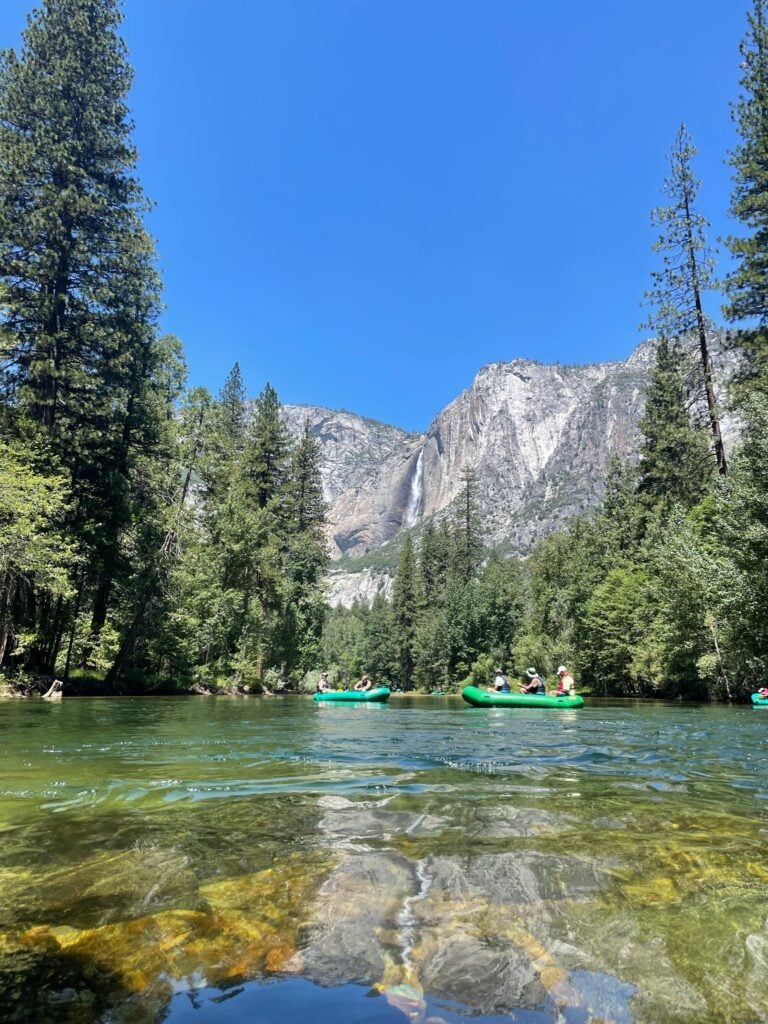
While floating, be aware of your surroundings. It is very easy to get lost in the scenery or while taking photos. The current can quickly sweep you into debris and loose branches/trees in the water. These can pop your float and be a pain to get out of.
It is important that everyone is able to swim at a basic level. The depth of the Merced varies from less than 10 inches to greater than 6 feet. You will never be more than 10-15 feet from shallow shores, but the current can make it more difficult to swim to shore than you think. That being said, it is very safe for anyone who can swim.
Float in groups of 2 or more. Never float alone, as it can be very difficult to call for help in an emergency, especially if you lose your phone.
Lastly, try to keep a comfortable distance between you and other groups of floaters. This is meant to be a relaxing activity, and the river can get overcrowded very quickly. Once a few groups of floaters mix, it can be hard to keep track of where everyone is, which can get stressful. With the current, it may not be as easy as you think to regroup everyone back together.
Get our done‑for‑you, 7-9-day route with exact drives, maps, and must‑see stops so you don’t waste time in traffic or miss the best views.
Inside the guide:
*Day‑by‑day plan for Yosemite, Sequoia & Kings Canyon, including the best hikes, drives, and sites
*Details You Need: including time frames, driving routes, and where to sleep each night to reduce backtracking
*Best Friend Guarantee: Love it or get your money back
Do I need a permit? Nope! You can do this whenever you please without any permits.
Can I float the Merced multiple times in a day? You theoretically can float the river multiple times by taking the shuttle back to your starting point, but as far as I am aware, that is not really popular to do. I am usually pretty tired from the sun exposure and ready to head back to my car or chill on the beach after one time around. Unless you are floating during the first few days that the river opens for rafting, one time around should be plenty for most people.
How cold is the water? The water is roughly 60 degrees in the summertime, which usually feels pretty cold. It takes a bit to get acclimated, but you usually end up feeling really good after about 5-10 minutes of floating. Much of the float is directly in the sun, so you heat up (and burn) quickly.
How deep is the Merced? It varies greatly. Some parts are lower than 10 inches, while others are 6+ feet. This also really depends on the time of year. Talk to a ranger before floating to ensure it is safe to float.
How strong is the current? It also varies greatly throughout the year. It is strongest in May and weakest in August. As long as you have basic swimming skills, you will be perfectly fine.
Are there any accessibility-friendly options? Renting a raft is your best bet. They can help accommodate people of all abilities. You can try launching from those same spots as mentioned above, although it may be a bit more difficult.
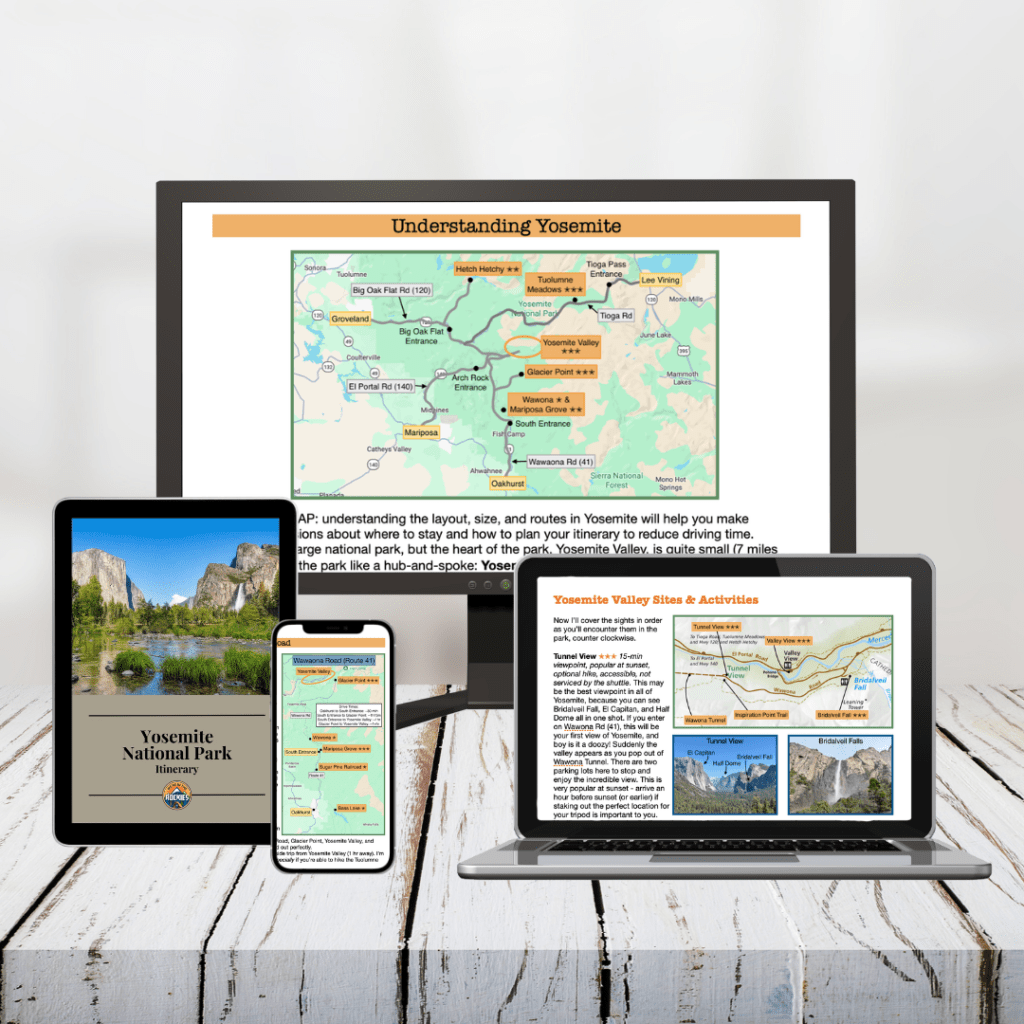
We’ve written a step-by-step guide for visiting Yosemite National Park. This guide contains 49 pages, including over 70 maps, charts, and images to keep you on course. We provide you with a 4-day itinerary featuring the best areas, waterfalls, hikes, scenic drives, and dining recommendations.
YOSEMITE TRIP PLANNER: To read or watch all of our content about Yosemite National Park, check out our Yosemite Homepage.
THINGS TO DO: Don’t miss all that Yosemite has to offer, including hiking, things to do in Yosemite Valley, and floating the Merced River.
WHERE TO EAT: Don’t miss the best places to eat in Yosemite National Park
WHERE TO STAY: Learn all you need to know about where to stay inside and outside the park
KNOW BEFORE YOU GO: Find out how to get there, the best time to visit, which is the best entrance, and all about driving around Yosemite.